
Ocular Genomics
243 Charles Street Boston, MA 02114 Contact us
Diagnostic Testing
Support our research
Explore our labs
Ocular Genomics MENU
Ocular Genomics
  • Meet the Team
  • Services
    • Biobank Core Services
    • Bioinformatics and Statistics Core
    • Functional Genomics (Zebrafish) Core
    • Gene Transfer Vector
      • Rates
      • Order Information
      • Contact Us
    • Genetic Diagnostic Testing Service
      • Pricing
    • Genomics Core Services
      • Sample Processing
      • Sequencing
      • Other Genomics Services
    • IRD service
  • Labs
    • Amamoto lab
      • Lab Members
    • Biobank Core
    • Bujakowska Lab
      • Lab Members
      • Publications
    • Comander Lab
      • Lab Members
      • Publications
    • Engle Lab
    • Functional Genomics Core (Zebrafish Facility)
      • Lab Members
    • Genetic Counseling Team
      • Team Members
    • Genomics Core Lab
      • Lab Members
    • iPS Research Lab
      • Lab Members
      • Grant support
      • Publications
    • Liu Lab
      • Lab Members
      • Publications
      • Projects
    • Mary Whitman Lab
      • Lab Members
    • MEEI Bioinformatics Center (MBC)
      • Lab Members
    • Pierce Lab
      • Lab Members
      • Publications
      • Projects
    • Segrè Lab
      • Selected Publications
    • Vandenberghe Lab
      • Lab Members
    • Wiggs Lab
      • Lab Members
  • News & Publications
    • RETINAL Transcriptome
  • Affiliates
  • Careers
  • Home
  • News
  • Ocular Genomics Institute researchers find a connection between changes in the extracellular matrix of Bruch’s membrane and the activation of the Alternative Complement Pathway in Macular Degeneration.
Recent Posts

  • OGI Director, Eric Pierce MD, PhD to introduce film and discuss its lessons for today.
  • Janey Wiggs
  • New publications from the Bujakowska lab
  • OGI members receive Reviewer’s Choice awards at ASHG 2025 meeting
  • OGI members present at RD 2025 symposium

Archives

  • November 2025
  • October 2025
  • September 2025
  • August 2025
  • July 2025
  • June 2025
  • May 2025
  • March 2025
  • January 2025
  • December 2024
  • November 2024
  • October 2024
  • September 2024
  • July 2024
  • June 2024
  • May 2024
  • January 2024
  • October 2023
  • July 2023
  • June 2023
  • May 2023
  • March 2023
  • February 2023
  • December 2022
  • November 2022
  • June 2021
  • May 2021
  • March 2021
  • February 2021
  • November 2020
  • October 2020
  • September 2020
  • August 2020
  • June 2020
  • August 2019
  • May 2019
  • April 2019
  • May 2018
  • April 2018
  • March 2018
  • November 2017
  • September 2017
  • June 2017
  • May 2017
  • April 2017
  • March 2017

Categories

  • News
  • Publication

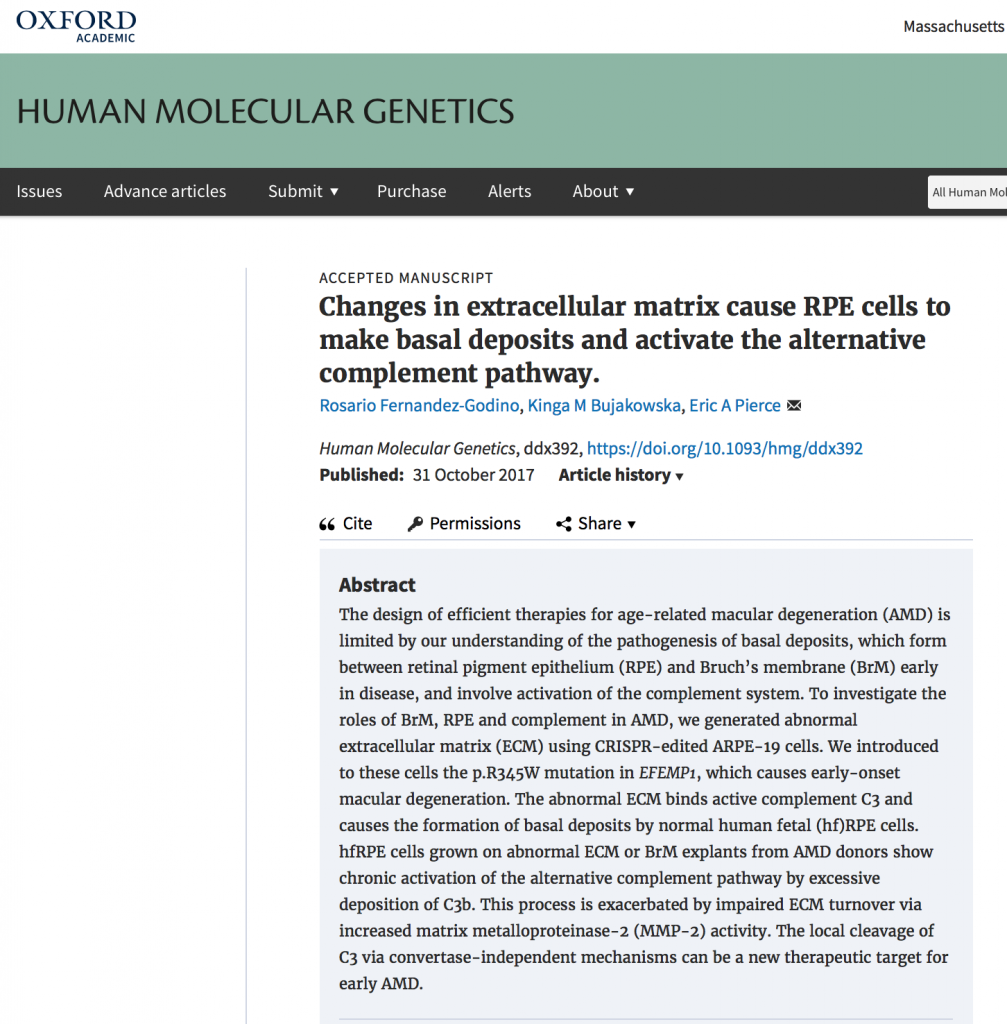
Ocular Genomics Institute researchers find a connection between changes in the extracellular matrix of Bruch’s membrane and the activation of the Alternative Complement Pathway in Macular Degeneration.
November 3, 2017

In a study published online this week in the Human Molecular Genetics journal, Drs. Rosario Fernandez-Godino, Dr. Kinga M. Bujakowska, and Dr. Eric Pierce of the Ocular Genomics Institute at the Massachusetts Eye and Ear, Harvard Medical School reported the remarkable finding that the formation of basal deposits in macular degeneration is primarily caused by activation of the alternative complement pathway triggered by abnormalities in the Bruch’s membrane.

Age-related macular degeneration (AMD) is a major cause of vision loss that affects more than 2 million people in the United States, unfortunately, there is no cure for AMD. The design of efficient therapies is limited by our understanding of the pathogenesis of basal deposits and drusen, which form between retinal pigment epithelium (RPE) and Bruch’s membrane early in disease. Multiple lines of evidence, including genetic association of complement variants with AMD, indicate that the complement system plays a key role in the pathobiology of the disease. Consistent with this, drugs that regulate the activation of the complement system have been developed for AMD. However, these medications have shown limited success in clinical trials to date.

In this article, Dr. Fernandez-Godino and colleagues have shown, for the first time, that the activation of the complement system in macular degeneration occurs via the alternative pathway due to abnormalities in the extracellular matrix of Bruch’s membrane. For these results, the investigators engineered RPE cells using the novel Clustered Regularly Interspaced Short Palindromic Repeats (CRISPR) in order to produce abnormal extracellular matrix that mimics the Bruch’s membrane of AMD patients. Further, the investigators cultured normal human fetal RPE cells on the abnormal extracellular matrix and on Bruch’s membrane explants from AMD donors. In both cases, the normal RPE cells showed chronic activation of the alternative complement pathway, resulting in increased cleavage of complement C3 and formation of basal deposits, which composition and structure was similar to the typical basal deposits found in AMD patients. The authors hypothesize that activation of C3 occurs via its physiological hydrolysis or tick-over, rather than via C3-convertase, which is the target of existing anti-complement drugs. The process has similarities with other diseases such as fibrosis, Alzheimer disease, and cancer.

The results reported here suggest that local alterations in complement activity participate in AMD pathogenesis earlier than previously described. Moreover, these findings could lead to the identification of novel therapeutic targets for preventing vision loss from macular degeneration.

Featured:

Contact Us

243 Charles Street
Boston, MA 02114

Contact Information

Associate Director: Hilary Scott, PhD.

Hilary_scott@meei.harvard.edu

L: +1 617-523-7900 x36441

Lead Research Technologist: Evelyn Harper

eharper3@meei.harvard.edu

L: +1 617-523-7900 x36437

Research Technologist: Sam Bell

sbell22@meei.harvard.edu

+1 617-523-7900 x33038

Location

The core is located on the 5th floor of Mass Eye and Ear Hospital, 243 Charles St., Room 566A

Labs

  • Amamoto lab
  • Biobank Core
  • Bujakowska Lab
  • Comander Lab
  • Engle Lab
  • Functional Genomics Core (Zebrafish Facility)
  • Genetic Counseling Team
  • Genomics Core Lab
  • iPS Research Lab
  • Liu Lab
  • Pierce Lab
  • Segrè Lab
  • Vandenberghe Lab
  • Whitman Lab
  • Wiggs Lab

Sitemap

  • Affiliates
  • Careers
  • Meet the Team
  • News & publications
  • Support Our Research
  • Services
  • Privacy
website-boston WebsiteBoston